Open-Cell vs. Closed-Cell Spray Foam: Which is Right for Your Insulation Job

Spray foam insulation is one of the most effective ways to improve energy efficiency, reduce moisture problems, and increase comfort in a building. But when it comes to choosing between open-cell and closed-cell spray foam, the decision isn’t always clear, especially if you’re a contractor trying to match the right product to the right job.
At PolyPier, we offer both open-cell and closed-cell insulation options. Here’s what you need to know about how they compare and when each one makes sense.
What’s the Difference?
The key difference lies in the structure of the foam’s cells.
- Open-cell spray foam has tiny open pockets, making it soft, flexible, and breathable.
- Closed-cell spray foam has tightly packed, closed cells, making it dense, rigid, and moisture-resistant.
That structural difference affects performance in real-world applications.
Open-Cell Spray Foam: Lightweight and Cost-Effective
Best for: Interior walls, attics, soundproofing, and residential insulation where moisture isn’t a major concern.
Advantages:
- Expands significantly to fill gaps and crevices.
- Provides excellent sound dampening.
- Lower cost per square foot than closed-cell foam.
- Great for interior wall cavities and attic applications.
Limitations:
- Absorbs moisture, so it’s not ideal in damp or exterior environments.
- Lower R-value per inch than closed-cell foam.
- Not structural—adds no significant support to walls.
Closed-Cell Spray Foam: Durable and Moisture-Resistant
Best for: Basements, crawl spaces, exterior walls, metal buildings, and any area where moisture resistance and strength matter.
Advantages:
- High R-value per inch (more insulation with less material).
- Acts as a moisture barrier—resists water absorption.
- Adds rigidity and strength to walls or structures.
- Suitable for both indoor and outdoor use.
Limitations:
- More expensive than open-cell foam.
- Less expansion means a more precise application is needed.
Which Should You Choose: Open-Cell Versus Closed-Cell Spray Foam?
Here’s a quick guide to help you match the foam to the project:
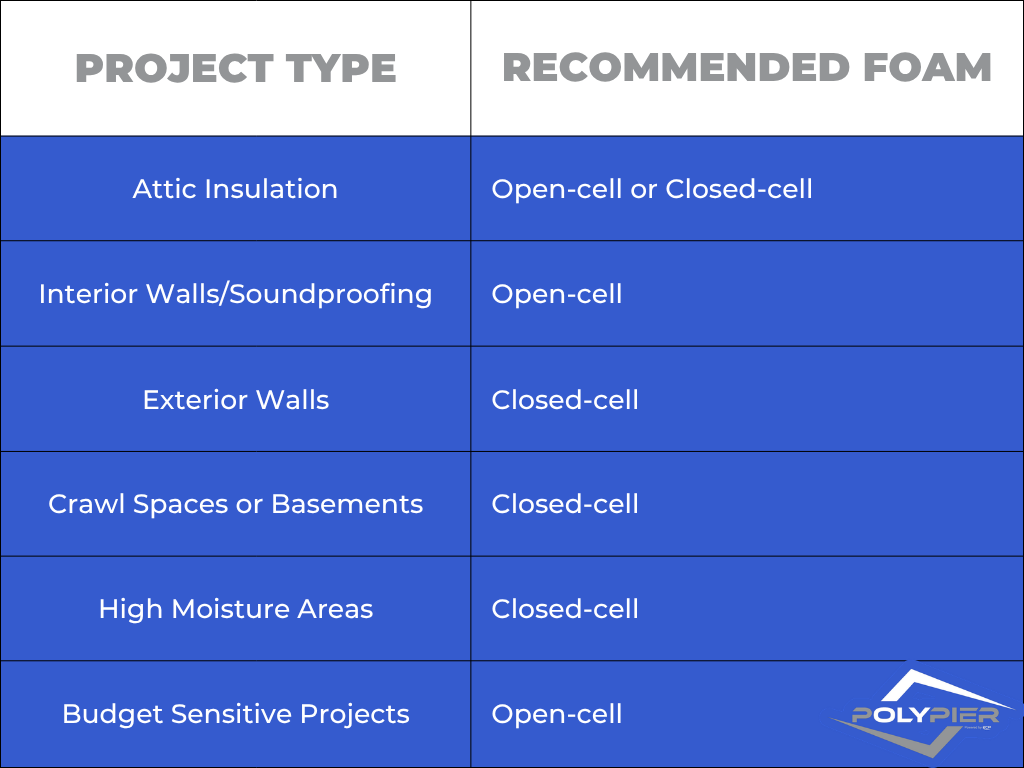
If you’re working in a climate with high humidity or you’re insulating a space that’s prone to moisture, closed-cell is usually the better option. For general interior insulation and sound reduction, open-cell can get the job done efficiently and affordably.
Why Choose PolyPier Products?
At PolyPier, we focus on products that meet the real needs of contractors—reliable performance, easy application, and long-term results. Whether you’re insulating new construction or upgrading an existing building, we have high-quality spray foam options to fit your goals.
- Open-cell spray foam: Great coverage, sound reduction, and affordability.
- Closed-cell spray foam: Long-term durability, energy efficiency, and water resistance.
Ready to Get Started?
Not sure which foam is right for your project? We’re here to help. Contact the PolyPier team today for product recommendations, tech support, or training resources to make your next job a success.