Spray Foam Insulation for Garages: Choosing the Right Foam for Lasting Performance
Garages present unique insulation challenges. Large overhead doors, temperature fluctuations, air leakage, and seasonal moisture exposure can all reduce building performance and make garages uncomfortable to use throughout the year. Whether insulating an attached garage, detached workshop, commercial service bay, or agricultural building, selecting the right spray polyurethane foam can significantly improve energy efficiency, air sealing, and moisture control.
For insulation contractors, spray foam offers advantages that traditional insulation materials often cannot match. By expanding to fill gaps, cracks, and irregular cavities, spray polyurethane foam creates a continuous insulation layer that helps improve the building envelope while reducing unwanted air movement.
PolyPier offers both open-cell and closed-cell spray foam insulation products, allowing contractors to choose the solution that best fits each project’s performance requirements.
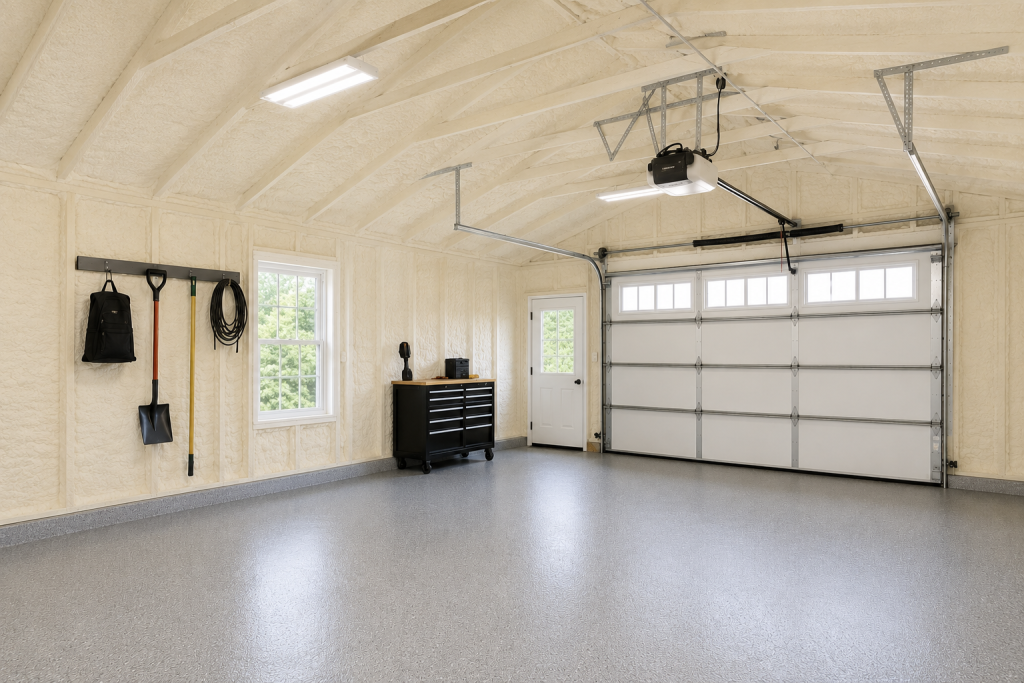
Why Garages Benefit from Spray Foam Insulation
Unlike conditioned living spaces, garages are frequently exposed to outdoor temperatures, humidity, and air infiltration. Even attached garages can become major sources of energy loss when walls, ceilings, and rim joists are not properly insulated.
Spray polyurethane foam helps contractors address these common challenges by creating an effective air seal while providing long-term thermal performance.
Benefits include:
- Reduced air infiltration
- Improved thermal efficiency
- Better moisture management
- Reduced condensation
- Improved occupant comfort
- Enhanced durability of the building envelope
Open-Cell vs. Closed-Cell Spray Foam
Selecting the appropriate spray foam depends on the building design, climate, and project goals.
| Feature | Open-Cell Spray Foam | Closed-Cell Spray Foam |
| Density | Lower density | Higher density |
| Air sealing | Excellent | Excellent |
| Moisture resistance | Moderate | Excellent |
| Vapor barrier | No | Yes (when installed to appropriate thickness) |
| Sound reduction | Excellent | Very good |
| Structural rigidity | Minimal | Adds rigidity to wall assemblies |
| Typical applications | Interior walls, ceilings, sound control | Garages, exterior walls, pole barns, commercial buildings, moisture-prone areas |
Rather than viewing one product as “better,” contractors should evaluate the performance objectives of each project to determine the most appropriate insulation system.
Choosing the Right Spray Foam for Garage Projects
Open-cell spray foam is often selected when sound control, air sealing, and interior insulation are primary goals. It performs well in enclosed wall cavities where moisture exposure is limited and additional structural rigidity is not required.
Closed-cell spray foam is frequently preferred for garages because of its higher R-value per inch, excellent moisture resistance, and ability to strengthen wall and ceiling assemblies. Its dense, closed-cell structure makes it particularly well suited for garages, workshops, agricultural buildings, and commercial facilities where humidity, condensation, or temperature extremes are common.
Typical Garage Applications
Contractors use spray foam insulation across a wide variety of garage projects.
| Garage Type | Why Spray Foam Performs Well |
| Attached garages | Improves energy efficiency and reduces air leakage between the garage and living space |
| Detached garages | Creates a more comfortable year-round workspace |
| Workshops | Improves temperature control for equipment and occupants |
| Automotive service garages | Helps maintain consistent indoor conditions |
| Agricultural building | Reduces condensation and improves building performance |
| Commercial maintenance facilities | Improves thermal efficiency while helping control moisture |
Spray Foam vs. Traditional Insulation
| Performance Category | Spray Polyurethane Foam | Fiberglass Batts |
| Air Sealing | Excellent | Limited |
| Energy efficiency | High | Moderate |
| Moisture resistance | Excellent (closed-cell) | Can retain moisture |
| Fits irregular cavities | Yes | Limited |
| Long-term performance | Excellent | Varies |
| Reduces air leakage | Yes | Limited |
Why Contractors Choose Spray Foam
Professional insulation contractors continue to specify spray polyurethane foam because it provides more than thermal resistance alone. Properly installed spray foam contributes to a tighter building envelope while helping improve energy efficiency, moisture management, and overall building durability.
Additional contractor advantages include:
- Expands to seal difficult-to-reach gaps and penetrations
- Adheres to most common building materials
- Reduces uncontrolled air movement
- Supports long-term building performance
- Helps improve occupant comfort
- Suitable for both residential and commercial applications
Building Performance Starts with the Right Insulation
Choosing between open-cell and closed-cell spray foam is about selecting the right product for the application’s performance requirements. By understanding each foam’s strengths, insulation contractors can deliver solutions that improve energy efficiency, control moisture, and create more durable buildings.
Whether insulating a residential garage, commercial service facility, agricultural building, or workshop, PolyPier spray foam insulation products provide contractors with reliable solutions backed by ECP’s commitment to quality and technical expertise.
Frequently Asked Questions
Spray foam insulation is an excellent choice for many garage applications because it provides insulation and air sealing in a single application. The appropriate foam type depends on the building design, climate, and project goals.
Closed-cell spray foam is often selected for garages due to its higher R-value per inch, moisture resistance, and ability to add rigidity to wall and ceiling assemblies. However, open-cell foam may be appropriate for certain interior applications where sound control and air sealing are the primary objectives.
Open-cell foam is lighter, expands more during installation, and excels at sound control. Closed-cell foam is denser, offers greater moisture resistance, provides a higher R-value per inch, and can increase structural rigidity.
Yes. Properly installed spray foam helps reduce uncontrolled air movement that can contribute to condensation. Closed-cell spray foam is particularly effective in environments where moisture resistance is a priority.
Absolutely. Spray polyurethane foam is commonly used in detached garages, workshops, agricultural buildings, commercial service bays, and other structures where improved thermal performance and air sealing are desired.
Unlike fiberglass batts, spray foam expands to fill gaps and irregular cavities, helping reduce air leakage while providing long-term thermal performance. Closed-cell spray foam also offers superior moisture resistance and increased structural rigidity.
Ready to Expand Your Spray Foam Services?
Whether you’re adding insulation services to your business or looking for high-performance spray foam products backed by expert support, PolyPier offers open-cell and closed-cell solutions designed to meet the demands of today’s contractors.
Visit our Become a Partner page to learn how PolyPier products, training, and technical resources can help grow your business.