Warehouse Floor Repair Without Shutting Down Operations
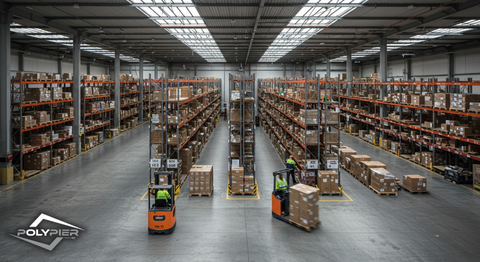
Uneven or sinking warehouse floors are more than an inconvenience. They slow down forklifts, damage equipment, create safety risks, and can even disrupt inventory flow. The problem is that many traditional repair methods require shutting down large sections of a facility, which costs time and money most warehouse managers do not have.
Concrete lifting with polyurethane foam offers a way to repair warehouse floors while keeping operations moving.
Why Warehouse Floors Settle
Warehouse floors take a beating every day. Heavy loads, constant traffic, and long-term soil movement all contribute to settlement over time. Common causes include:
- Poorly compacted soil beneath the slab
- Water intrusion that washes out supporting soils
- Repeated heavy point loads from racking systems and machinery
- Aging concrete slabs with voids underneath
When a slab loses support, it settles. Ignoring the issue usually leads to more damage and higher repair costs later.
The Problem With Traditional Repair Methods
Traditional solutions like slab replacement or mudjacking often create major disruptions inside a warehouse.
Concrete replacement requires demolition, debris removal, long cure times, and full shutdowns of affected areas. Mudjacking introduces heavy materials that can add weight to already unstable soil and often requires larger access holes.
For busy warehouses, downtime is often the biggest concern, not just the repair itself.
How Polyurethane Foam Repairs Floors With Minimal Disruption
Polyurethane concrete lifting foam provides a faster, cleaner alternative that works well in active warehouse environments.
The process involves injecting high-density foam beneath the slab through small holes drilled in the concrete. As the foam expands, it fills voids, stabilizes the soil, and lifts the slab back to a level position.
Because the foam cures quickly, repaired areas can often be reopened within minutes instead of days.
Key Benefits for Active Warehouses
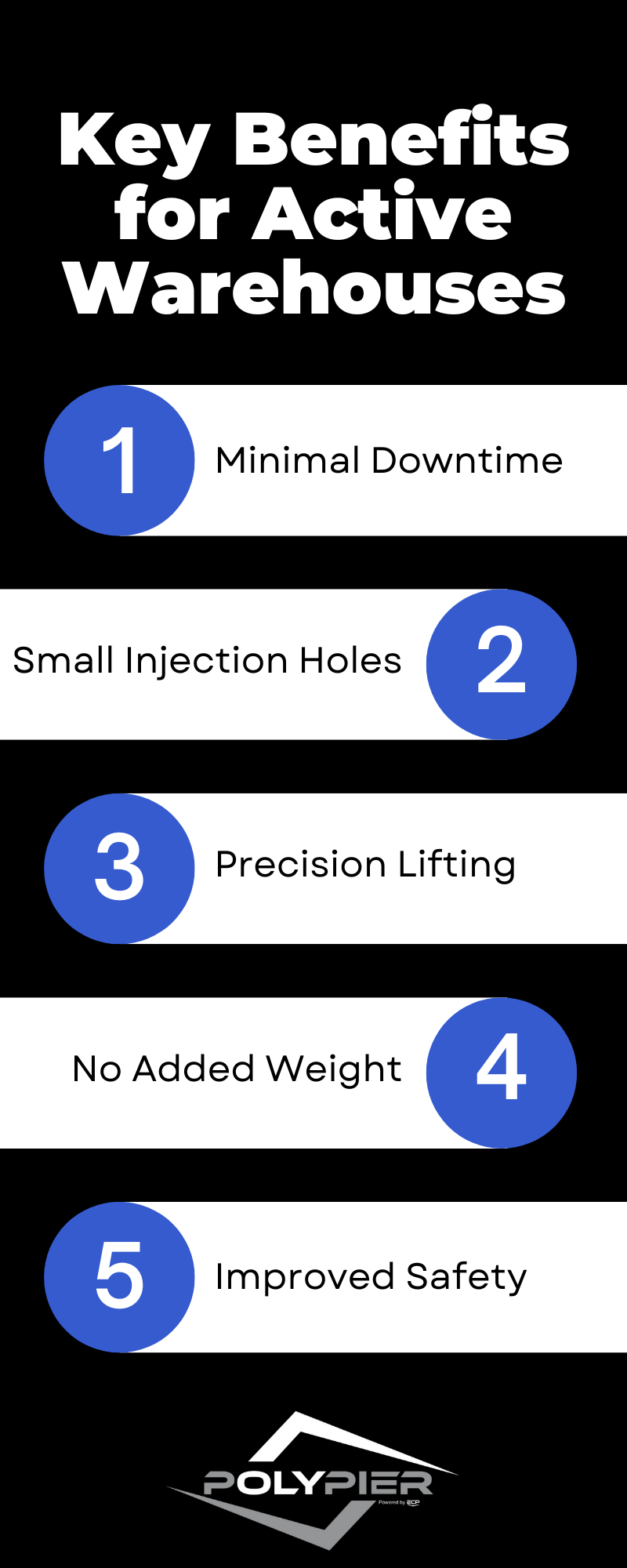
Concrete lifting with polyurethane foam is especially well suited for warehouses that need to stay operational.
Minimal Downtime
Foam cures fast, allowing forklifts and foot traffic to resume quickly.
Small Injection Holes
Holes are typically much smaller than those required for other methods, resulting in a cleaner finished surface.
Precision Lifting
Contractors can control the lift, helping restore smooth transitions between slabs and reducing trip hazards.
No Added Weight
Unlike slurry-based methods, foam is lightweight and does not increase stress on weak soils.
Improved Safety
Level floors reduce the risk of accidents involving forklifts, pallet jacks, and employees.
Ideal Warehouse Applications
Polyurethane foam lifting works well in many warehouse scenarios, including:
- Settled slab joints and interior floors
- Uneven loading dock approaches
- Sunken areas around racking systems
- Trip hazards in high-traffic aisles
- Voids beneath concrete caused by water intrusion
These repairs can often be completed in phases to further reduce disruption.
A Strong Selling Point for Contractors
For contractors, warehouse floor repair is an opportunity to provide high-value solutions with minimal operational impact. Being able to offer a repair method that avoids shutdowns makes your services more attractive to facility managers and property owners.
Polyurethane foam allows contractors to solve real problems quickly while protecting the client’s productivity.
Looking for a Smarter Way to Repair Warehouse Floors?
If you’re a contractor looking to expand your concrete lifting services or take on commercial and industrial projects, PolyPier polyurethane foam is designed to meet the demands of warehouse environments.
Contact us to learn more about our foam solutions, training opportunities, and how PolyPier can help you tackle warehouse floor repairs without shutting down operations.