When Is It Time to Expand from Residential to Commercial Concrete Lifting?
Many successful concrete lifting businesses begin by repairing residential driveways, sidewalks, patios, and pool decks. Over time, however, many contractors reach the same question:
“What’s next?”
Expanding into commercial and industrial concrete lifting can open the door to larger projects, repeat clients, and long-term business growth. The transition doesn’t require starting over—it requires building on the skills you’ve already developed while understanding the unique needs of commercial projects.
With the right training, technical support, and polyurethane foam systems, contractors can confidently expand their services and pursue opportunities that help grow their business for years to come.
Signs You’re Ready to Expand into Commercial Concrete Lifting
Many contractors assume commercial work requires an entirely different business model. In reality, it’s often the natural next step after building experience with residential concrete lifting.
You may be ready to expand if:
- Your residential schedule stays consistently booked.
- Customers or general contractors are asking about larger projects.
- Your crew has developed confidence with polyurethane concrete lifting.
- You’re looking for higher-value projects and recurring revenue opportunities.
- You’re ready to grow beyond one-time residential repairs.
Commercial projects often use the same core principles of lifting and stabilizing concrete—you simply apply those skills to larger, more complex environments.
What Makes Commercial Concrete Lifting Different?
The fundamentals of polyurethane concrete lifting remain the same whether you’re repairing a residential driveway or stabilizing a warehouse floor. The biggest differences involve project planning, communication, and minimizing disruption.
Commercial projects often include:
- Larger concrete slabs
- Heavier traffic loads
- Active business operations
- Tighter project schedules
- Increased emphasis on safety and documentation
- Coordination with property managers, facility managers, or general contractors
Understanding these differences helps contractors prepare for larger projects without feeling overwhelmed.
Residential vs. Commercial Concrete Lifting
| Residential Projects | Commercial Projects |
|---|---|
| Homeowners | Property and facility managers |
| Smaller concrete slabs | Large slab systems and structural pavements |
| Flexible scheduling | Projects scheduled around business operations |
| Typically one-time repairs | Opportunities for recurring maintenance and repair |
| Driveways, patios, sidewalks, pool decks | Warehouses, loading docks, manufacturing facilities, retail centers, municipal sidewalks |
While commercial projects may be larger in scope, the goal remains the same: restore settled concrete safely, efficiently, and with minimal disruption.
Commercial Concrete Lifting Opportunities
Contractors experienced with polyurethane concrete lifting are often surprised by the variety of commercial projects available.
Common opportunities include:
- Warehouses
- Distribution centers
- Manufacturing facilities
- Loading docks
- Retail shopping centers
- Office campuses
- Apartment and condominium communities
- Schools and universities
- Hospitals and healthcare campuses
- Municipal sidewalks and public walkways
- Parking lots and concrete approaches
These projects often require reliable repair solutions that allow facilities to continue operating with as little downtime as possible.
What Commercial Clients Care About Most
Residential homeowners often focus on appearance, safety, and affordability.
Commercial clients usually have different priorities.
They’re often asking:
- How quickly can operations resume?
- Will this interrupt customers or employees?
- Can the repair be completed without closing the facility?
- Will this help reduce liability and trip hazards?
- Is the repair durable enough for heavy traffic?
When contractors understand these priorities, they can present concrete lifting as a business solution—not just a repair.
Why Polyurethane Foam Is an Excellent Fit for Commercial Projects
Commercial facilities rarely have the luxury of extended downtime.
Polyurethane concrete lifting offers several advantages that make it well-suited for busy commercial environments, including:
- Fast project completion
- Precise slab lifting
- Lightweight material that helps fill underlying voids
- Minimal disruption compared to concrete replacement
- Fast cure times that often allow areas to return to service quickly
These benefits help contractors solve problems while allowing businesses to continue operating whenever possible.
Common Mistakes Contractors Make When Expanding into Commercial Work
Moving into commercial projects isn’t just about taking on larger jobs—it’s about approaching them differently.
Some common mistakes include:
- Underestimating project planning and scheduling
- Focusing only on price instead of overall value
- Overlooking communication with facility managers and stakeholders
- Failing to clearly explain how concrete lifting minimizes operational downtime
- Assuming commercial customers have the same priorities as homeowners
Avoiding these pitfalls helps contractors build trust and position themselves as professional long-term partners.
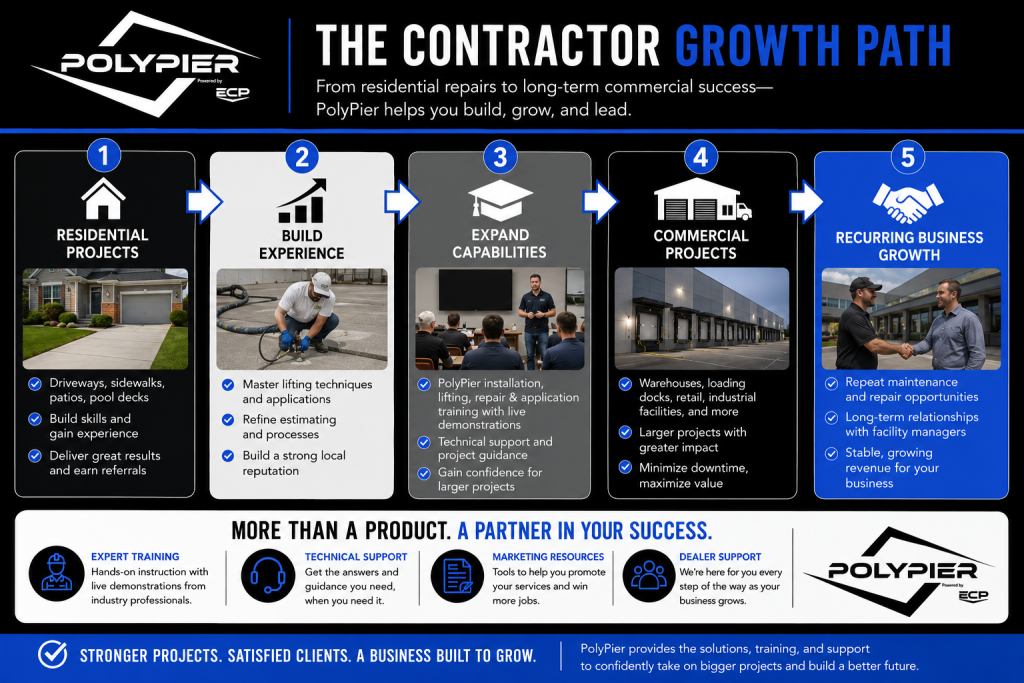
How PolyPier Helps Contractors Grow
Growing into commercial concrete lifting isn’t about learning an entirely new trade—it’s about building on the experience you already have.
PolyPier by Earth Contact Products (ECP) supports contractors with:
- Professional polyurethane foam systems
- Product and application training featuring classroom instruction and live demonstrations
- Technical guidance from experienced professionals
- Marketing resources designed to help contractors promote their services
- Ongoing dealer support as businesses continue to grow
Whether your next project is a residential driveway or a commercial warehouse floor, PolyPier’s training focuses on the proper installation, lifting, repair, and application of polyurethane concrete lifting systems, giving contractors the knowledge and confidence to deliver consistent results across a wide range of projects.
Frequently Asked Questions
Many contractors begin exploring commercial work once they have established experience with residential projects, built a reliable crew, and are looking for larger projects or recurring business opportunities.
The lifting process is similar, but commercial projects often involve larger slabs, heavier loads, stricter scheduling requirements, and coordination with facility managers or other stakeholders.
Commercial projects often involve larger scopes of work and can create opportunities for repeat business through ongoing maintenance and repair relationships. Profitability ultimately depends on project complexity, operational efficiency, and proper estimating.
Polyurethane concrete lifting is commonly used for warehouse floors, loading docks, manufacturing facilities, retail centers, municipal sidewalks, parking areas, office campuses, apartment communities, and other settled concrete surfaces that remain structurally sound.
When the appropriate polyurethane system is selected and properly installed, polyurethane foam is widely used to help lift, stabilize, and support concrete in both residential and commercial environments.
PolyPier training is designed to teach contractors proper polyurethane installation, lifting, repair, and application techniques through classroom instruction and live demonstrations. The knowledge gained applies across many residential and commercial concrete lifting applications, helping contractors confidently expand their capabilities as their business grows.
Ready to Take Your Concrete Lifting Business to the Next Level?
Expanding into commercial concrete lifting isn’t about changing your business—it’s about growing it. By building on the skills you’ve already developed, understanding the priorities of commercial clients, and partnering with experienced industry leaders, you can confidently pursue larger projects and create new opportunities for long-term success.
PolyPier by Earth Contact Products is committed to helping contractors grow through quality polyurethane foam systems, comprehensive training, technical support, and dealer resources. If you’re ready to expand beyond residential projects, contact the PolyPier team to learn how we can help you take the next step.