How to Evaluate a Concrete Lifting Job Before You Inject Foam
A sunken concrete slab may look like a straightforward lifting job. But what you see at the surface is only part of the story.
Before drilling the first injection point, a concrete lifting contractor needs to understand why the slab moved, what is happening beneath it, and how the concrete is likely to respond during the lift.
Poorly compacted fill, erosion, water movement, soil settlement and subsurface voids can all contribute to sinking concrete. Cracks, joints, adjoining structures, utilities and the condition of the concrete itself can further affect how—and whether—the slab should be lifted.
That makes jobsite evaluation one of the most important skills a polyurethane concrete lifting contractor can develop.
Here is what contractors should look for before deciding that a slab is a good candidate for polyurethane foam injection.
Start With the Most Important Question: Why Did the Concrete Sink?
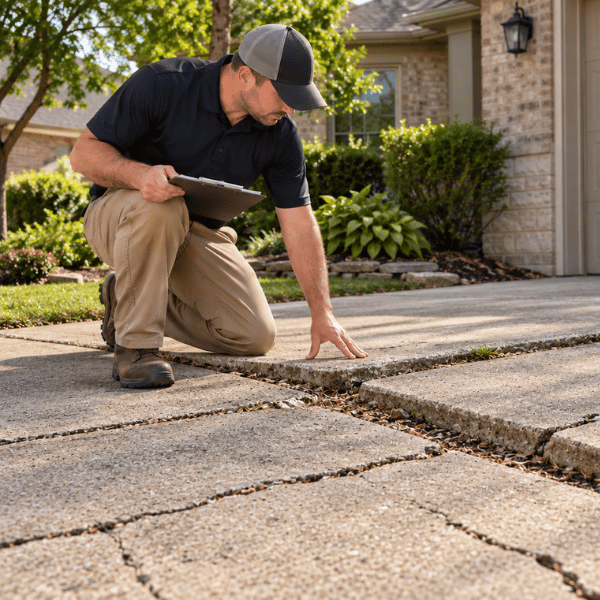
Don’t begin the evaluation by asking, “How much does this slab need to come up?”
First ask:
Why did it go down?
Concrete slabs depend on the material beneath them for support. When that support changes, the concrete above it can settle.
Potential causes include:
- Poorly compacted fill beneath the original slab
- Natural soil settlement or consolidation
- Erosion that removes supporting material
- Water moving beneath or alongside the slab
- Drainage problems
- Washout around downspouts or drainage discharge areas
- Voids that have developed beneath the concrete
- Changes in moisture conditions within supporting soils
More than one condition may be contributing to the problem.
Identifying the likely cause helps determine whether polyurethane lifting is appropriate and whether another problem needs to be corrected as part of the overall repair strategy.
Simply raising the visible low spot without considering why it developed can leave the underlying cause unaddressed.
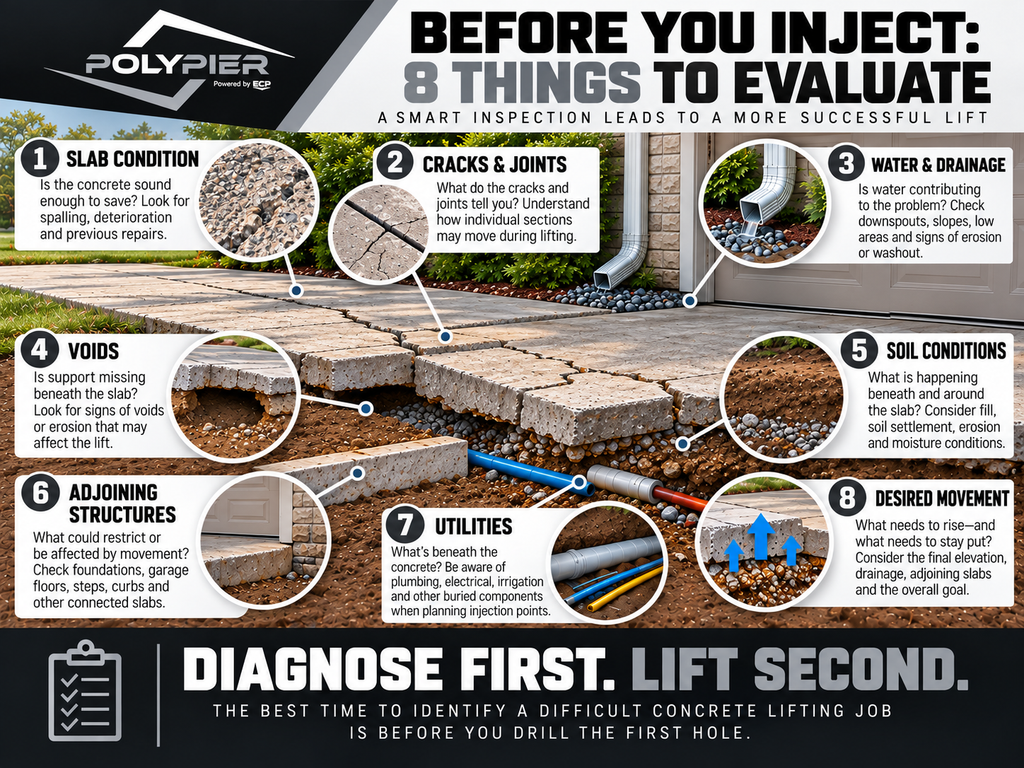
1. Evaluate the Condition of the Concrete
Polyurethane concrete lifting is intended to reposition and support existing concrete. That means the concrete itself needs to be worth saving.
Look beyond the elevation difference and inspect the entire slab.
Pay attention to:
- Significant cracking
- Multiple intersecting cracks
- Broken or loose sections
- Spalling or surface deterioration
- Previous repairs
- Movement along existing cracks
- Damage around joints and edges
- Signs that sections may move independently during lifting
A cracked slab isn’t automatically a poor candidate for lifting. Contractors regularly encounter concrete with cracks that may still be serviceable.
The more important question is whether the slab has enough integrity to respond predictably to lifting and continue performing after the repair.
If the concrete has deteriorated to the point that raising it will not restore a usable surface, replacement or another repair method may make more sense.
The goal isn’t simply to prove that a slab can be lifted. It is to determine whether lifting is the right repair.
2. Read the Cracks and Joints
Cracks tell part of the story of how a slab has moved.
Look at their location, direction and relationship to the surrounding concrete.
Has one side of a crack dropped below the other? Does the crack extend through several areas? Has the slab broken into sections that could react independently?
Control and expansion joints also matter because they often define how individual sections can move.
Before developing an injection plan, contractors should understand where the concrete can move freely and where movement may be restricted.
This becomes especially important around:
- Garage floors
- Driveways adjoining garage slabs
- Patios against foundations
- Stoops and steps
- Pool decks
- Curbs
- Sidewalk intersections
- Commercial slabs adjoining structural elements
Concrete does not necessarily rise as one uniform piece. Recognizing how the slab is divided before injection helps the contractor anticipate how different sections may respond.
3. Look for Evidence of Voids Beneath the Slab
A visible depression at the surface does not tell you exactly what is happening underneath.
Settlement can leave empty space between the underside of the concrete and the supporting material. Erosion and washout can also create substantial voids.
Contractors should look for clues such as:
- Gaps visible along slab edges
- Erosion near the concrete
- Soil washing away from the perimeter
- Unsupported slab edges
- Evidence of water traveling beneath the concrete
- Previous settlement in the surrounding area
Understanding the likely extent of a void matters because polyurethane may first need to fill available space and establish support before meaningful lifting occurs.
The project may therefore involve void filling and stabilization as well as lifting.
This distinction can affect material selection, injection planning, estimating and customer expectations.
4. Follow the Water
Water deserves special attention during almost every exterior concrete evaluation.
Look beyond the slab itself and examine how water moves across the property.
Check:
- Downspout locations
- Gutter discharge
- Drainage slopes
- Low areas where water collects
- Soil erosion
- Areas that remain unusually wet
- Nearby drainage systems
- Irrigation
- Runoff from roofs, pavement or adjoining properties
If water has been washing supporting material away from beneath a driveway or sidewalk, lifting the slab addresses the resulting settlement—but the drainage condition may still need attention.
Water beneath the slab can also affect polyurethane selection. PolyPier offers polyurethane formulations specifically designed for applications where moisture or saturated conditions are present.
A contractor should understand those conditions before arriving at the injection stage.
5. Consider the Supporting Soil
The slab is only part of the system.
The soil and fill beneath it determine how well that concrete is supported.
Contractors won’t always have complete information about subsurface conditions during an initial inspection, but visible clues can help identify potential concerns.
Consider:
- Has surrounding soil settled?
- Is fill pulling away from the slab?
- Is there evidence of erosion?
- Does the area appear to have been built on disturbed or filled soil?
- Are other slabs nearby experiencing similar settlement?
- Are there signs of persistent moisture?
- Is the problem isolated or part of a larger settlement pattern?
These observations can help distinguish a relatively localized slab problem from a broader soil or site condition.
Polyurethane products can be used for lifting, void filling and, with products designed for that purpose, soil stabilization. Determining which problem you’re actually addressing is an important part of choosing the appropriate repair strategy.
6. Inspect Adjoining Structures Before You Lift
One of the easiest mistakes to make is evaluating only the slab that appears low.
Concrete often interacts with other construction.
A driveway may meet a garage floor. A patio may abut a foundation. A sidewalk may connect to steps. A pool deck surrounds a structure with plumbing and other components nearby.
Before lifting, identify anything that could restrict movement or be affected by it.
Look closely at:
- Foundations
- Garage slabs
- Stoops
- Steps
- Curbs
- Retaining walls
- Columns
- Masonry
- Door thresholds
- Adjacent concrete sections
- Pool structures
- Drainage components
The objective isn’t necessarily to return every slab to where someone believes it originally sat.
The objective is to restore appropriate support and elevation without creating a new problem somewhere else.
That requires understanding the relationships between the slab and everything surrounding it.
7. Know What Is Below the Concrete
Not everything beneath a slab is soil.
Depending on the property and application, contractors may encounter:
- Plumbing
- Drain lines
- Electrical lines
- Irrigation
- Pool plumbing
- Utility lines
- Drainage systems
- Abandoned pipes
- Other buried components
These considerations can affect drilling locations, injection points and the overall feasibility of the project.
Interior slabs, commercial properties and pool decks can require particular attention because important systems may be located beneath or immediately adjacent to the concrete.
Never treat subsurface conditions as an afterthought.
8. Determine How the Slab Needs to Move
Once you’ve evaluated the concrete and surrounding conditions, consider what a successful lift actually looks like.
Ask:
- Which area is low?
- Which sections need to move?
- Which sections should remain where they are?
- Is the goal leveling, restoring drainage, reducing a trip hazard, stabilizing the slab—or a combination?
- What surrounding elevations must be maintained?
- How might movement in one area affect another?
This is where evaluation begins turning into an injection plan.
Injection points and sequencing shouldn’t be treated as a universal pattern that can be applied to every slab. They should reflect the slab configuration, underlying conditions and movement required for that particular project.
Careful planning gives the contractor greater control once injection begins.
9. Establish Realistic Expectations Before Starting
A good job evaluation isn’t complete until the contractor and customer have the same understanding of the expected outcome.
Existing concrete has a history.
It may be cracked, weathered, previously repaired or connected to construction that has also moved over time.
Before work begins, document existing conditions and explain what the repair is intended to accomplish.
That might mean:
- Reducing or eliminating a trip hazard
- Improving drainage
- Restoring a more appropriate elevation
- Filling an underlying void
- Stabilizing an area against additional movement
- Bringing adjoining slabs closer to their intended relationship
Avoid promising a result that the existing concrete or site conditions cannot reasonably support.
Setting expectations during the evaluation helps protect both the contractor and the customer.
When Should Concrete NOT Be Lifted?
Knowing when to walk away from a lifting job is part of being a professional concrete lifting contractor.
Polyurethane is a versatile repair material, but it does not make every damaged slab a good candidate for lifting.
A contractor should reconsider the repair approach when:
The Concrete Is Too Deteriorated to Save
If the slab is badly broken, extensively deteriorated or no longer structurally serviceable, raising it may not provide a worthwhile repair.
Lifting Won’t Correct the Actual Problem
Sometimes uneven concrete is only a symptom of a larger issue. If the underlying problem requires another type of structural, drainage or site repair, simply raising the slab may not be sufficient.
The Slab Cannot Move Safely
Concrete that is constrained by adjoining construction may not have room to move to the desired elevation without affecting another component.
Subsurface Conditions Are Unknown or Create Unacceptable Risk
Utilities, plumbing, significant washouts, unusual voids or other hidden conditions may require additional investigation before injection.
The Customer’s Expected Result Isn’t Realistic
Sometimes the requested outcome simply isn’t achievable with the existing slab.
A professional contractor should be willing to explain why.
Turning down an unsuitable project can prevent callbacks, damage and an unhappy customer. More importantly, it demonstrates that your company is recommending repairs based on the conditions—not simply selling an injection service.
A Simple Pre-Lift Evaluation Checklist
Before drilling, make sure you can answer these questions:
- Why did the slab settle?
- Is the existing concrete worth saving?
- What do the cracks and joints tell me about how it may move?
- Is there likely a void beneath the slab?
- Is water contributing to the problem?
- What are the supporting soil conditions?
- What structures or slabs are connected to this concrete?
- What utilities or other components may be beneath it?
- Which areas need to move—and which need to stay put?
- What is the appropriate end result?
- Does the customer understand what the repair can realistically accomplish?
- Is polyurethane lifting actually the right repair for this job?
If you cannot confidently answer those questions, the project may require more investigation before injection begins.
Better Concrete Lifting Starts Before the Injection Gun Comes Out
Successful polyurethane concrete lifting isn’t just about knowing how to operate the equipment.
It requires learning how to read the jobsite.
A contractor who understands why a slab settled, how it is likely to move, what lies beneath it and what conditions surround it can make better decisions about material selection, injection planning and the repair itself.
Those evaluation skills become even more important as contractors move from straightforward sidewalks and driveways into pool decks, interior floors, commercial slabs and larger projects.
PolyPier by Earth Contact Products supports professional contractors with polyurethane products designed for concrete lifting, void filling and soil stabilization, along with hands-on education through PolyPier training.
Because the best time to identify a difficult lifting job is before you drill the first hole.
Frequently Asked Questions About Evaluating Concrete for Polyurethane Lifting
A crack does not automatically rule out polyurethane lifting. Contractors should evaluate the severity and pattern of cracking, condition of the concrete and how individual slab sections may move during lifting. Severely deteriorated or extensively broken concrete may be better suited to another repair approach.
Start by evaluating the condition of the slab, cause of settlement, cracks and joints, underlying support, drainage, surrounding structures and subsurface conditions. Concrete that remains serviceable and can move safely may be a candidate for polyurethane lifting, but each project should be evaluated individually.
Common contributors include poorly compacted fill, soil settlement, erosion, water movement, drainage problems and loss of support beneath the concrete. Identifying the likely cause of settlement is an important part of selecting the appropriate repair.
Polyurethane formulations designed for void filling can be used to fill spaces beneath concrete and provide support. A project may require void filling or stabilization before or in conjunction with lifting, depending on site conditions.
Moisture conditions should be evaluated before injection. PolyPier offers hydrophobic and hydro-insensitive polyurethane formulations designed for applications involving water or saturated conditions. Product selection should be based on the specific application and site conditions.
Replacement or another repair method may be more appropriate when the concrete itself is badly deteriorated, the slab cannot move safely, lifting will not address the underlying problem, or site conditions make polyurethane injection inappropriate. The repair decision should be based on the entire project—not simply the amount of settlement.
Build Your Concrete Lifting Skills with PolyPier
Learning to evaluate concrete is just as important as learning to lift it.
ECP’s PolyPier training gives contractors an opportunity to develop their knowledge of polyurethane materials, equipment, injection planning and field techniques through classroom instruction and hands-on experience.
Whether you’re adding concrete lifting to an existing contracting business or looking to sharpen the skills of your current team, professional training can help you approach each project with a better understanding of what is happening before the first injection is made.
Learn more about PolyPier Training and professional polyurethane concrete lifting solutions from Earth Contact Products.