Mudjacking vs Concrete Replacement vs Polyjacking
Concrete Repair Methods

You’ve discovered that parts of your driveway are sunken, and now you must repair them. There are numerous options for fixing a sunken concrete driveway, so how will you determine which method is best? This article aims to provide a clearer understanding of restoring your concrete to its original glory using the most effective method.
Mudjacking Sunken Concrete
What is mudjacking?
Mudjacking is the process of drilling holes into a concrete slab, such as a driveway, that needs repair. Once the holes have been drilled, slurry (a mixture of sand, cement, coal, and limestone) is poured through the hole under the sunken slab.
How long do mudjacking repairs last?
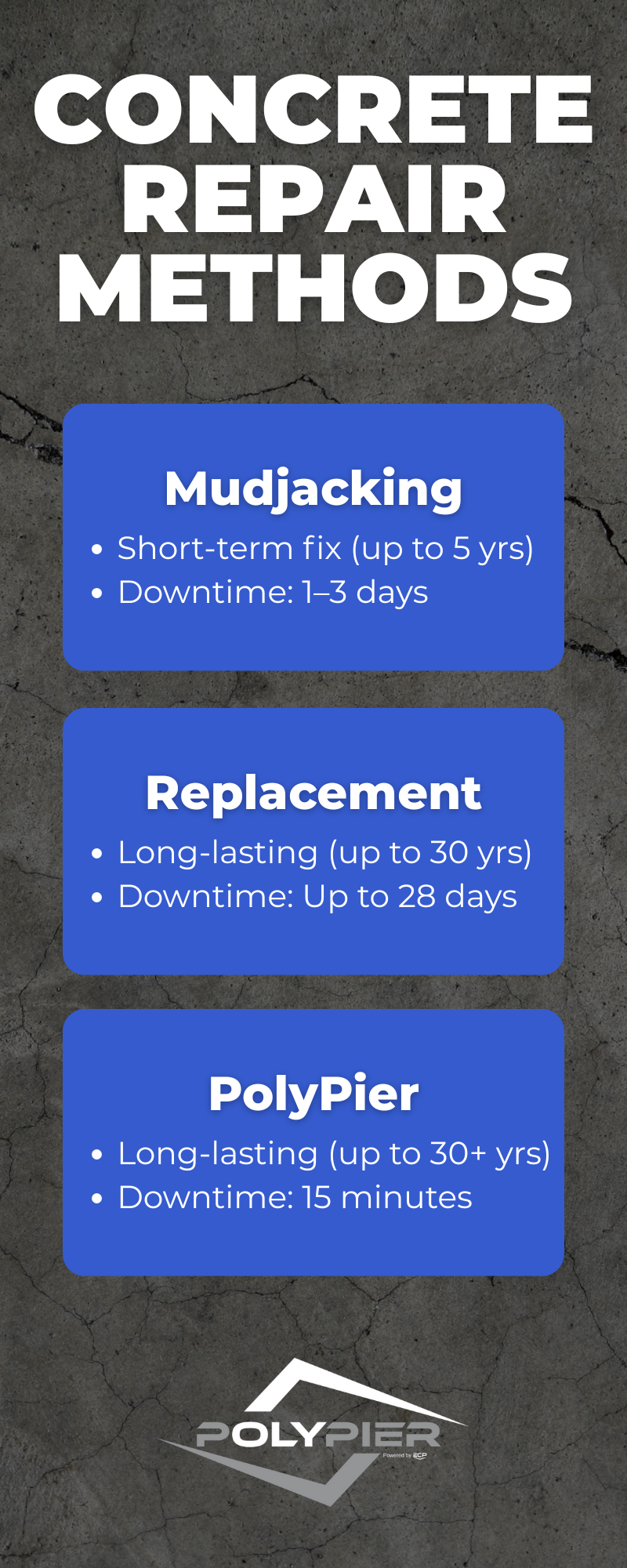
Mudjacking can last up to five years. The reason mudjacking does not last longer is that the slurry is not water-resistant, and it can erode and shrink.
How long does the mudjacking process take?
Once the slurry has been placed under the sunken slab, it must be left alone for one to three days before it can be used.
Replacement of Sunken Concrete
What is replacement?
Some people choose to replace concrete rather than repair it. Replacing concrete is much more intensive than repairing it. The process involves tearing up the old driveway, pouring a new one, and allowing it to set and dry thoroughly.
How long does the new concrete driveway last?
A concrete driveway can last up to 30 years with the proper maintenance.
How long does the process of replacing a concrete driveway last?
The process of ripping up and re-pouring a driveway can take 1-3 days. Once the concrete has been poured, it can take up to 28 days to dry completely and maintain its strength.

Using PolyPier on Sunken Concrete
What are PolyPier and Polyjacking?
Polyjacking is the process of drilling small holes into the concrete that requires repair and filling the void under the concrete with polyurethane foam. The PolyPier process begins with drilling tiny holes into the concrete slab to be repaired. PolyPier is a polyurethane foam that expands and lifts sunken concrete.
How long does PolyPier last?
PolyPier lasts as long as the concrete surface, which can be up to 3 decades.
How long does the PolyPier application process take?
The PolyPier application is a quick process that will be completed within a couple of hours. It takes about 15 minutes and is usable right away.