Concrete Lifting Injection Points: Why Placement and Sequence Matter
Polyurethane concrete lifting is about more than finding the lowest part of a slab, drilling a hole and injecting foam.
Before the first injection point is drilled, a contractor has decisions to make. Where has the slab settled? Where might support be missing beneath it? How does the slab need to move? What other concrete or structures could be affected by that movement?
Those questions help determine where injection points should be placed and how a contractor approaches the sequence of a lift.
A thoughtful injection plan gives the contractor a way to work systematically while watching how the slab responds. Because every jobsite is different, the goal isn’t to memorize one drilling pattern. It’s to understand the slab well enough to develop a plan—and know when conditions require that plan to change.
Injection-Point Planning Starts Before You Drill

The first step in planning injection points doesn’t involve a drill. It involves evaluating the concrete and the conditions around it.
Before establishing an injection pattern, look at the entire repair area. Consider:
- The size and shape of the slab
- The direction and severity of settlement
- Existing cracks and control joints
- Adjacent concrete
- Steps, curbs, foundations and other structures
- Areas where voids may exist beneath the concrete
- Drainage and erosion patterns
- Utilities or other obstructions beneath the slab
- How the slab ultimately needs to move
A visibly low area is important, but it doesn’t necessarily tell the entire story.
Settlement may be connected to a loss of support somewhere beneath the slab. Understanding the likely cause and extent of that loss helps contractors make more informed decisions about where to begin.
Contractor Tip: Don’t let the lowest point on the concrete become the only point you evaluate. Think about what may be happening beneath the entire slab.
Why Contractors Use Injection-Point Grids
Planning injection points in a grid or organized pattern provides a framework for approaching the lift.
Rather than drilling holes wherever they appear convenient, contractors can use the pattern to think through how they will access different areas beneath the concrete and how movement in one area may influence another.
The appropriate layout can vary depending on the project. A driveway panel, sidewalk section, patio, warehouse floor or irregularly shaped slab can each present different considerations.
That’s why an injection grid should be viewed as a planning tool rather than a one-size-fits-all template.
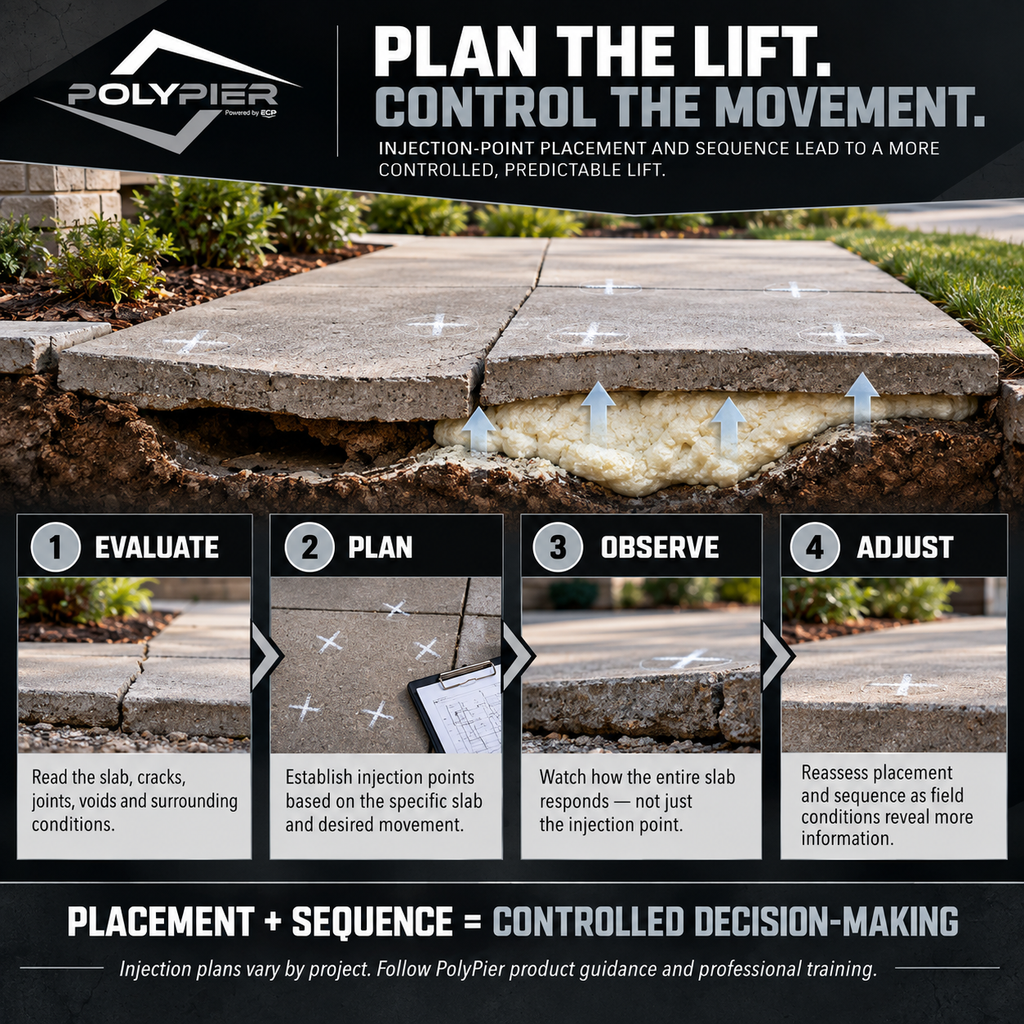
The purpose is controlled decision-making: establish a plan before injection begins, observe what happens and adjust based on actual field conditions.
Slab Size and Geometry Affect the Plan
Concrete doesn’t always come in convenient rectangles.
Slabs may wrap around structures, meet steps or foundations, contain multiple control joints, or transition into adjoining concrete. Some areas may be relatively level while another portion has settled significantly.
All of these characteristics can affect how a contractor approaches injection-point placement.
Before drilling, consider how the slab is divided and supported. Look at edges, corners, joints and transitions. Think about whether the concrete is likely to move as one section or whether different portions may respond independently.
The objective isn’t simply to create access beneath the slab. It’s to create access that supports a controlled lifting strategy.
Cracks and Control Joints Can Help Tell the Story
Cracks shouldn’t automatically be treated as random defects.
Their location and direction can provide useful information about how a slab has moved over time. Control joints also identify intentional divisions within the concrete that may affect how different sections respond during lifting.
For example, one portion of a slab may have settled while an adjoining section remains relatively stable. A crack may indicate differential movement between two areas.
Before establishing injection points, contractors should look at these features as part of the overall settlement pattern.
What is the concrete telling you about how it has moved—and how it may move during the repair?
Think About the Void, Not Just the Low Spot
One of the most important concepts in concrete lifting happens below the surface.
The location of visible settlement and the location of missing support aren’t necessarily identical.
Water movement, erosion, poor compaction and other soil conditions can create voids beneath concrete. Those unsupported areas may extend beyond the portion of the slab that appears visibly low.
That’s why evaluating the conditions beneath the slab is an important part of injection planning.
If a contractor focuses exclusively on the surface elevation, an important part of the support problem may be overlooked.
Injection-point planning should therefore consider two related objectives:
Where does the slab need to move?
Where does support need to be restored?
Those aren’t always the same question.
Why Injection Sequence Matters
Once injection begins, placement is only part of the strategy.
Sequence matters because each injection can influence how the slab responds.
Polyurethane expands beneath the concrete, and that reaction needs to be carefully observed. Movement in one area can affect neighboring areas, joints, cracks and adjoining concrete.
Rather than treating every injection point as an independent repair, contractors should consider how the points work together as part of the overall lift.
A planned sequence allows the contractor to make an adjustment, observe the result and determine what the slab needs next.
That creates a much more controlled process than concentrating entirely on one location and trying to achieve the full correction at once.
Controlled Movement Is the Goal
Concrete lifting isn’t a race to get the low point back to elevation.
Controlled movement matters.
As polyurethane is introduced beneath the slab, contractors can monitor how the concrete responds and use that information to guide subsequent injections.
The response may confirm the original plan—or reveal something unexpected beneath the surface.
The slab may begin moving differently than anticipated. An adjoining area may respond. Material movement beneath the concrete may indicate a larger unsupported area than expected.
These observations are valuable.
Instead of forcing the slab to follow the original plan, experienced contractors use what they’re seeing to make decisions throughout the lift.
Plan the lift. Make a controlled adjustment. Observe the response. Reassess.
That mindset is one of the reasons concrete lifting requires both technical knowledge and hands-on experience.
Watch More Than the Injection Point
It’s easy to focus on the spot where polyurethane is being injected. But the entire repair area deserves attention.
During a lift, contractors may need to monitor:
- The slab being raised
- Existing cracks
- Control and expansion joints
- Adjacent slabs
- Slab edges and corners
- Steps and curbs
- Garage thresholds
- Foundation walls or other nearby structures
- Areas where material movement may become visible
Small changes away from the injection point can provide important information about what’s happening underneath the concrete.
Maintaining a broader view helps the contractor understand whether the slab is responding as expected.
Your Original Injection Plan May Need to Change
A good injection plan provides direction. It shouldn’t prevent a contractor from responding to field conditions.
Concrete can hide a lot.
Once work begins, a contractor may discover that a void extends farther than expected, the supporting material is different from what surface conditions suggested, or the slab responds differently than anticipated.
When that happens, the original plan may need to change.
That’s not necessarily a failure of planning. It’s one reason planning and observation work together.
A knowledgeable contractor starts with a strategy but continues evaluating the project throughout the repair.
Common Injection-Point Planning Mistakes
While every concrete lifting project is different, several planning habits can make controlled lifting more difficult.
Drilling Before Evaluating the Entire Slab
Starting too quickly can mean missing cracks, joints, drainage problems or adjoining structures that should influence the plan.
Concentrating Only on the Lowest Area
Visible settlement doesn’t necessarily reveal the full extent of unsupported concrete beneath the slab.
Using the Same Pattern for Every Project
Different slab sizes, shapes and site conditions require different considerations.
Trying to Accomplish Too Much From One Location
Controlled lifting requires monitoring how the entire slab responds rather than focusing exclusively on one injection point.
Watching the Injection Point Instead of the Repair Area
Movement elsewhere can provide important information about what’s happening beneath the slab.
Ignoring the Reason the Concrete Settled
Injection-point planning should be based on the conditions causing the problem, not just the appearance of the concrete.
Connect Injection Planning to the Overall Jobsite Evaluation
Injection-point strategy shouldn’t exist in isolation.
Before deciding where and how to inject, contractors should already understand the condition of the slab, likely voids, drainage, soil conditions and nearby structures.
Environmental conditions also matter. Slab temperature, polyurethane material temperature, moisture and frozen ground can all influence whether conditions are appropriate for the planned repair.
That creates a logical progression for every project:
Evaluate the concrete → Understand the conditions → Plan the injection points → Control the lift → Monitor the result
Each step informs the next.
Knowing the Concept Is Different From Controlling a Lift
Articles can explain why injection-point placement and sequence matter.
In-person training provides something an article can’t: the opportunity to see how concrete actually responds as polyurethane is introduced beneath it.
PolyPier School combines instruction with practical training designed to help contractors better understand polyurethane concrete lifting, equipment, materials and application techniques.
Contractors can see how experienced professionals evaluate a project, establish injection points, monitor slab movement and make adjustments as conditions change.
For contractors adding polyurethane concrete lifting to their services—or crews looking to improve consistency—this experience can help turn the principles behind concrete lifting into practical field skills.
Frequently Asked Questions About Concrete Lifting Injection Points
PolyPier School provides professional training covering polyurethane concrete lifting techniques, equipment, materials and jobsite application.
Hands-on instruction allows contractors to see and practice concepts that can’t be fully demonstrated through written information alone.
Injection points provide access for polyurethane beneath the slab. Their placement should reflect slab geometry, settlement, suspected voids, cracks, joints, adjoining structures and the movement needed to complete the repair.
A planned approach helps contractors work systematically rather than treating each injection as an isolated step.
No single pattern is appropriate for every project. Slab size, shape, settlement, support conditions and surrounding structures can vary significantly.
Contractors should evaluate the individual project and follow applicable product and training guidance.
Each injection can influence how the slab and surrounding areas respond.
A controlled sequence allows contractors to observe movement and use that information when deciding how to proceed with subsequent injections.
Not necessarily.
Visible settlement doesn’t always show the full extent or location of unsupported areas beneath a slab. Contractors should evaluate the entire repair area and consider likely voids and support conditions when developing an injection plan.
Yes. Cracks, joints and slab divisions can provide information about previous movement and how different portions of the concrete may respond during lifting.
They should be considered during the overall jobsite evaluation.
Yes. Conditions beneath concrete aren’t always fully visible before work begins.
Contractors should monitor slab response throughout the lift and be prepared to reassess their approach when field conditions differ from expectations.
Build Better Concrete Lifting Skills With PolyPier
Successful polyurethane concrete lifting requires more than the right material and equipment. It requires understanding the slab, planning the repair and knowing how to respond as conditions change.
Injection-point placement and sequence are part of that process.
PolyPier by ECP provides professional polyurethane systems, equipment and training for contractors who want to build or strengthen their concrete lifting services.
For contractors who want to move beyond understanding the concepts and develop practical application skills, PolyPier School provides training with experienced industry professionals.