Why Concrete Lifting Training Is Essential for Contractors
Learning how to lift concrete with polyurethane foam involves much more than operating the equipment. Successful concrete lifting requires understanding soil conditions, foam chemistry, injection techniques, and proper slab evaluation. That’s why professional contractor training is one of the most important investments a concrete lifting business can make.
PolyPier Training, offered by Earth Contact Products (ECP), gives contractors the knowledge and confidence to perform polyurethane concrete lifting safely, efficiently, and consistently. Whether you’re adding concrete lifting to your business or refining your team’s skills, proper training helps reduce callbacks, improve customer satisfaction, and prepare you for larger commercial projects.
Concrete Lifting Is Not a One-Size-Fits-All Process
Every project is different. Soil conditions, slab thickness, moisture levels, and load requirements all impact how a job should be approached. Without training, it is easy to over-lift, under-lift, or apply the wrong foam for the situation.
Training helps contractors understand how to evaluate each job before work begins. That includes knowing where to inject, how much material to use, and how to adjust for changing conditions in real time.
Precision Matters More Than Ever
One of the biggest advantages of polyurethane foam lifting is precision. Slabs can be raised gradually and controlled to within fractions of an inch. That precision, however, only comes with proper technique.
Training teaches contractors how to:
- Control lift speed and pressure
- Monitor slab movement during injection
- Avoid cracking or stressing the concrete
- Achieve smooth, even results
When crews are trained, they work with confidence instead of guessing.
What Do Contractors Learn During PolyPier Training?
During PolyPier Training, contractors receive instruction that goes beyond operating equipment. Training focuses on understanding why lifting techniques work so crews can make informed decisions in the field.
Topics commonly covered include:
- Evaluating concrete slabs before lifting
- Reading soil conditions
- Identifying voids beneath concrete
- Choosing the correct polyurethane foam
- Injection patterns and spacing
- Lift sequencing
- Equipment operation and maintenance
- Jobsite safety
- Troubleshooting difficult lifting situations
- Best practices for residential and commercial projects
Reducing Risk and Callbacks
Mistakes in concrete lifting can be costly. Overcorrection, uneven lifting, or foam placed in the wrong location can lead to unhappy clients and repeat visits. In commercial settings, mistakes can also disrupt operations or create safety concerns.
Training helps reduce these risks by giving contractors a clear process to follow. When teams understand best practices, jobs are completed correctly the first time, protecting both reputation and profit.
Understanding the Materials You Are Using
Polyurethane foam systems come in different formulations designed for specific applications. Some foams are better suited for fast lifting, while others are designed for void filling or stabilization. Certain projects require moisture-resistant or hydrophobic options.
Training helps contractors understand:
- Which foam to use for different environments
- How temperature and moisture affect performance
- Proper mixing and injection techniques
Knowing the material leads to better outcomes on every job.
| Without Training | With PolyPier Training |
|---|---|
| Trial-and-error approach | Proven installation methods |
| Greater risk of callbacks | Improved consistency |
| Difficult troubleshooting | Better problem-solving skills |
| Lower confidence | Greater confidence during lifting |
| Slower production | Improved efficiency |
| Limited project scope | Ready for more complex work |
Benefits Contractors Often Experience After Training
Contractors who complete the training often see improvements such as:
- Faster project completion
- More accurate slab lifting
- Fewer material waste issues
- Greater confidence when estimating jobs
- Improved customer communication
- Reduced callbacks
- Ability to bid larger commercial work
- Increased credibility with customers

Building Credibility with Customers
Training is not just about improving skills. It also helps contractors stand out in a competitive market. Homeowners, property managers, and facility operators want to work with professionals who know what they are doing.
Being able to explain the process clearly and confidently builds trust. When clients see that your team is trained and supported by a manufacturer like PolyPier, it reinforces your credibility and professionalism.
Supporting Growth into Larger Projects
As contractors look to expand into commercial, industrial, or infrastructure work, training becomes even more important. Larger slabs, heavier loads, and active facilities leave less room for error.
Training gives contractors the knowledge needed to take on more complex projects while maintaining quality and safety. It also helps crews work more efficiently, which is critical when downtime needs to be kept to a minimum.
PolyPier Training Supports Contractor Success
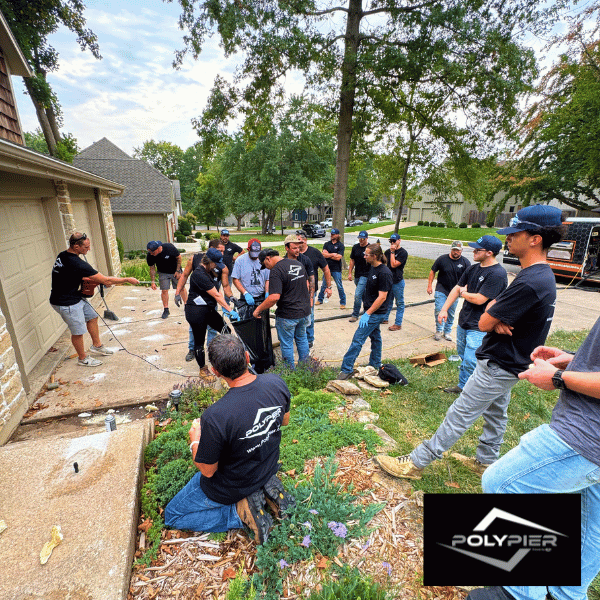
PolyPier training programs are designed to help contractors get the most out of their concrete lifting services. With a combination of classroom instruction and hands-on experience, contractors learn how to apply foam systems correctly in real-world conditions.
The goal is simple: help contractors deliver reliable results, protect their reputation, and grow their business with confidence.
PolyPier Training typically spans multiple days and combines classroom instruction with live product demonstrations, giving contractors time to learn both the theory and practical application of polyurethane concrete lifting.
No. Training benefits both new contractors adding concrete lifting services and experienced installers looking to improve consistency, learn new products, or expand into larger projects.
Training focuses on PolyPier polyurethane systems, including proper foam selection, injection techniques, equipment operation, and best practices for lifting and stabilizing concrete.
Yes. Proper training helps contractors evaluate jobs accurately, select the right foam, and perform controlled lifting, reducing the likelihood of uneven lifts, overcorrection, or unnecessary return visits.
Yes. Training discusses techniques that prepare contractors for residential, commercial, and infrastructure projects where precision and efficiency are critical.
Ready to Build a More Successful Concrete Lifting Business?
Whether you’re launching a new concrete lifting service or expanding into larger commercial projects, professional training provides the knowledge needed to work safely, improve efficiency, and deliver consistent results.
Explore upcoming PolyPier Training events to learn from experienced instructors, see live product demonstrations, and discover how manufacturer-led education can help your business grow.